

Account fraud isn’t a one-off event, it’s an industry. Operators run shops, set prices, manage stock and respond to customers. They specialize, collaborate, and follow the money into whichever industries are paying out. For a retailer, it is a customer’s account quietly emptied of points, gift card credit and stored payment value. For a quick service restaurant (QSR), reward points cashed out at the counter. For airlines and hotels, it is miles and points spent on a stranger’s trip.
KasadaIQ continuously monitors this activity across nine industries, tracking account sales, pricing, stock levels and the operators behind them. The result is a benchmark dataset that shows where adversaries are focused, how the threat is trending and how industries stack up against each other. This blog walks through what that looked like in retail, QSR, airlines and accommodation in Q1 2026, the macro forces shaping each industry and the Q1 benchmarks behind the story.
The Adversaries Behind the Market: KYC Bypass and Synthetic Identity at Scale
In Q1 2026, KasadaIQ observed 13.2 million account sales tagged “verified,” “KYC” (know your customer) or “2FA,” representing $24.6 million in observed revenue. The premium has shifted decisively toward persistent, verification-proof access. Stolen credentials are still being traded, but the money has moved up-market, and the buyers paying it want accounts that won’t trip a step-up challenge mid-session.
That market doesn’t run itself. Behind the 13.2 million sales sit organized fraud operators selling the tradecraft to bypass verification at scale and, increasingly, to fabricate identities outright. They run customer support, post update logs, restock on a schedule and compete on coverage and reliability the way any supplier would.
Verification Bypass as a Service
KasadaIQ is tracking organized fraud groups advertising bypass services across 50+ platforms. The catalog covers most of what a verification flow throws at a user:
- Selfie liveness bypass, including “head rotation” verification used by tier-one platforms
- KYC bypass spanning 250+ countries, sold as a service rather than a one-off
- Passport templates and utility bills from 50+ countries, used to seed new accounts that pass document checks on the first try
- US SSN card templates for accounts that need a US identity attached
- Ready-made PayPal accounts with 2FA already attached, sold as drop-in payment infrastructure
- “Fraud starter kits” bundling browser setup tutorials, anti-detect configurations and the documents needed to onboard
One operator we track, which we refer to as Casio Carl, claims coverage across 250+ countries and runs the operation like a managed service. Buyers name the platform, Casio Carl delivers a verified account or a bypass package, with a guaranteed turnaround. The pitch isn’t “I have stolen credentials,” it’s “I can get you through the door of any platform you name.”
The shift this represents is one of accessibility. Bypassing modern verification used to require a level of skill most fraudsters didn’t have. Now it’s a service with a catalog and a price list, and the skill stays with the supplier while everyone downstream just buys the output.
Synthetic Identity, Productized
According to LexisNexis’s 2026 Cybercrime Report, fabricated identities overtook true identity theft globally for the first time in 2025. Synthetic identities have no victim to raise the alarm; there’s no genuine cardholder calling the bank, no real person noticing a strange login, no fraud report tying the activity back to a known individual. The account passes verification, ages on the platform, builds a transaction history and is then either sold or used directly.
KasadaIQ is tracking a Canadian-focused operator, which we refer to as Maple Forge, selling custom synthetic identities with established credit profiles for around $200. Maple Forge’s product isn’t a document, it’s a person on paper, with the artifacts to back it up. Optional add-ons include:
- Postal verification (a working address that will receive and forward mail for confirmation flows)
- A physical bank card shipped to a drop location
- A SIM for 2FA and recovery codes
For $200 plus a few add-ons, a buyer gets an identity that can open accounts, receive statements, pass phone verification and survive the kind of checks designed to catch a stolen credential in seconds. The economics flip the old assumption on its head: it’s now cheaper to fabricate an identity than to steal one and keep it alive through the verification gauntlet.
Industry Impacts
The four industries covered in this post sit directly downstream of this market. The retail, QSR, airlines and accommodation industries all depend on verification at signup and recovery, all carry stored value that makes a verified account worth paying for and all show up in the catalogs of operators like Casio Carl. The Q1 benchmarks below are what that demand looks like in motion.
The Q1 Macro Picture
That adversary infrastructure didn’t operate in a vacuum. Three macro forces shaped how Q1 2026 played out across the retail, QSR, airlines and accommodation industries.
- Macroeconomics increased the value of compromised accounts. Tariffs and the 2026 Iran War-led oil disruption drove up retail prices. The stored value sitting inside compromised accounts (credits, points, locked-in pricing) carries more purchasing power as a result.
- AI rapidly became infrastructure for part of the adversary market. Daily sales of paid AI accounts on criminal marketplaces jumped 640x (from 6 to 3,845) in Q1 2026. Seasoned operators remain hesitant, but novices using no-code tools are driving rapid adoption.
- Legal frameworks trail agentic AI. The Amazon v. Perplexity ruling applied the Computer Fraud and Abuse Act to AI agents, separating user permission from platform authorization. Platforms react unevenly: eBay banned “buy-for-me” agents, Amazon mandates agent ID, and others use DMCA §1201 against scraping. For retail, accommodation, and airlines, compromised accounts are valuable due to dynamic pricing, loyalty point arbitrage, and stored credentials. Enforcement is currently limited to platform Terms of Service, with organizations setting interim boundaries until courts catch up.
Industry Benchmarks
Retail: Account Takeover Down, Bot Checkouts Up
Account Takeover
18%▼ Account Sales | 39%▼ Revenue | 1%▲ Active Shops | 3.5%▲ Total Stock | 64K Avg Stock by Brand | 91 Brands Targeted | 25%▼ Average Price |
Criminal marketplace data showed that account takeover in the retail industry remained high‑volume but reset from Q4: 145,317 sales (‑17.75%), 1,455 stores (+1.04%), 5,433,337 max stock (+3.47%), $361,646 revenue (‑38.71%) and $2.49 average price (‑25.45%). The sharper revenue decline versus unit decline indicates material price erosion and likely weaker conversion economics (higher fraud friction, lower urgency baskets and heavy competition among sellers).
Example of Verification Bypass in Action | A customer logs in to redeem a gift card balance and finds it gone. The account was sold for $2.49 last week, drained of points. The saved card used to ship orders to a reshipper before the alert email even hit the inbox. The buyer didn’t need to break in, they bought a verified login from a shop with a satisfaction guarantee. |
Bot Checkouts
3.4M Total Checkouts Observed | 122+ Brands Targeted in Bot Checkouts |
KasadaIQ observed 3.4 million bot checkouts across 122+ brands and 13 retail sub-industries in Q1. Footwear remained dominant at 73%, six of the top ten targeted brands sold collectibles (trading cards, “ugly-cute” figures) and pickleball paddles entered the target list for the first time. The hype-item economy keeps widening.
In Q1 2026, bot checkout activity was heavily drop-driven. Looking at total bot checkouts by day (see below), Thursday and Friday are the primary “drop days”. Weekends are quieter, with Saturday and Sunday combined accounting for only 11% combined for bot checkouts in Q1 2026. The average daily bot checkouts was 38K, but seven days had a surge of 100K+ checkouts.
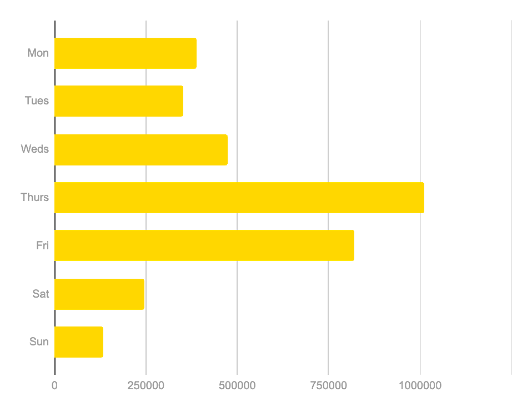
Seasonal themes had minimal impact. Lunar New Year at 1.1% and Valentine’s Day under 0.1% confirm that bots aren’t heavily chasing themed merchandise, they’re following hype and resale value regardless of seasonal tie-ins.
QSRs: The Volume Outlier
Account Takeover
41%▲ Account Sales | 3%▲ Revenue | 1.5%▼ Active Shops | 1%▲ Total Stock | 43K Avg Stock by Brand | 81 Brands Targeted | 27%▼ Average Price |
QSR was Q1’s volume outlier with 60,627 sales (+40.69%) against 672 stores (‑1.47%) and 3,181,669 max stock (+0.63%). Revenue increased marginally to $113,929 (+2.58%) because average price collapsed to $1.88 (‑27.06%). This is consistent with bulk, lower‑value inventory moving quickly rather than a surge in premium accounts. Bots tolerate high failure rates against QSR targets because the per-account economics still work even when most attempts fail. Mobile apps, online ordering and loyalty programs continuously broaden the surface, and tariffs and inflation are increasing the purchasing power of stored credits and loyalty points.
Example of Verification Bypass in Action | A loyalty account changes hands for less than $2. The buyer redeems the points at a counter that same afternoon. The account passed step-up verification on the way in, because the seller bundled a working SIM with the listing. The legitimate customer notices weeks later, if at all, and by then the account has been resold twice. |
Accommodation: Premium Shift, Smaller Market
Account Takeover
18%▲ Account Sales | 44%▲ Revenue | 4%▼ Active Shops | 11%▼ Total Stock | 48K Avg Stock by Brand | 13 Brands Targeted | 22%▲ Average Price |
Accommodation went the other way to retail this quarter. Q1 2026 accommodation listings strengthened materially: 22,283 sales (+17.98% Quarter-on-Quarter), 215 stores (‑4.02%), 470,356 max stock (‑10.51%), $152,816 revenue (+44.04%), and $6.86 average price (+22.12%). The combination of higher sales and higher unit pricing alongside lower advertised stock suggests demand firming towards higher‑quality accounts rather than a bulk‑inventory expansion.
Seasonal drivers fit the pattern: the January “Sunshine Saturday” booking surge and Lunar New Year both elevated login activity in ways that make credential stuffing easier to hide in background noise. The macroeconomic dynamic noted earlier (stored credits and loyalty points worth more as tariffs and oil disruption push prices up) applies significantly here.
Example of Verification Bypass in Action | A premium hotel account with elite status and a stored card sells for under $7. Before the legitimate guest knows anything is wrong, someone else is sleeping in a room booked under their name, having walked through a verification flow with a synthetic identity that’s been aging on the platform for six months. |
Airlines: Oversupply, Post-Holiday Reset
Account Takeover
15%▼ Account Sales | 26%▼ Revenue | 36%▲ Active Shops | 8%▲ Total Stock | 9K Avg Stock by Brand | 38 Brands Targeted | 13%▼ Average Price |
Airlines saw a post‑holiday reset: 24,264 sales (‑15.02%), 240 stores (+36.36%), 323,364 max stock (+7.94%), $280,101 revenue (‑25.71%) and $11.54 average price (‑12.61%). Rising store counts and stock alongside falling revenue and price indicates oversupply and a buyer market compared to Q4. Breach-driven identity exposure remains a key enabler in airlines specifically: the 2025 Qantas frequent-flyer data exposure and WestJet’s October 2025 disclosure of 1.2 million records continue to feed targeted social engineering and recovery-flow abuse.
Example of Verification Bypass in Action | A frequent flyer account with 200K miles is sold, transferred to a fresh profile that passed KYC on first try, and burned on a one-way international ticket before the alert email lands in the victim’s inbox. |
The full Q1 2026 KasadaIQ Threat Intelligence Report with all nine industry breakdowns, the 2026 predictions tracker and the full adversary intelligence is available here: https://www.kasada.io/reports/q1-2026-threat-intelligence-report/. Questions or peer engagement: [email protected].