New Threat Group “Earth Longzhi” Targeting Global Government, Infrastructure, Aviation, Health, and Finance Orgs

On November 9, 2022, Trend Micro researchers reported two campaigns they attribute to a new threat group Earth Longzhi, which they assess is a subgroup of APT41. Context Trend Micro researchers based the assessed connection between the groups on shared targets, shared Cobalt Strike metadata, code similarities, and shared tactics, techniques, and procedures (TTPs). Impact…

Read More


Mobile Application Security Best Practices

The use of mobile phones is expanding worldwide, with approximately 6.65 billion currently in use. As smartphones become ubiquitous, an increasing number of the world’s e-commerce transactions are taking place on mobile devices, leading to the coining of the term “mcommerce” to describe the new method of shopping. eMarketer predicts that by 2024 nearly 70%…

Read More

Sentinel Labs Report Links Black Basta Ransomware Group TTPs to FIN7

On November 3, 2022, Sentinel Labs researchers published a report linking the Black Basta Ransomware group to FIN7 (also known as Carbanak) based on shared tactics, techniques, and procedures (TTPs) between Black Basta tools and FIN7 tools. Key Takeaways Key findings for the report include: SentinelLabs researchers describe Black Basta operational TTPs in full detail,…

Read More

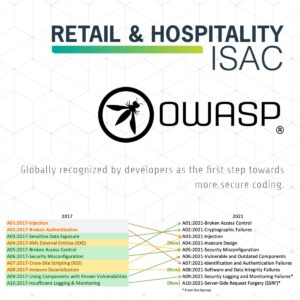
Top 10 Web Application Security Risks

According to the U.S Department of Commerce, e-commerce sales in the first quarter of 2022 accounted for 14.3% of total sales. Secure web applications are essential for modern retailers, but many are still struggling to combat common web application risks, including ones such as cross-site scripting and code injection that have been around for years,…

Read More

OpenSSL Patches Two High Severity Vulnerabilities with Significant Barriers to Exploitation

On November 1, 2022, OpenSSL developers released details of two vulnerabilities: CVE-2022-3786 and CVE-2022-3602. Context In an accompanying blog post, OpenSSL explained that they downgraded the severity of the vulnerabilities to high from the originally announced critical level due to technical barriers to exploitation. No in the wild exploits or proofs of concept (POCs) are…

Read More

The Role of WAFs in the DevSecOps Focused World of Modern Application Security

WAFs, or web application firewalls, have been around since the late 1990s, becoming popular in the early 2000s when OWASP formalized its top 10 list of application vulnerabilities. WAFs are designed to monitor and block suspicious HTTP traffic from reaching your web applications. This is typically done based on a series of rules that block…

Read More

Ransomware, BEC, and Phishing Top Cisco Talos Incident Response Trends Q3 2022 Report

Key Takeaways On October 25, 2022, Cisco Talos Incident Response (CTIR) researchers published their Quarterly Report: Incident Response Trends in Q3 2022. Key findings include: Ransomware was the top threat this quarter, a slight change from last quarter where commodity trojans surpassed ransomware by a narrow margin. Several high-profile ransomware groups appeared in CTIR engagements…

Read More

Application Security Challenges Caused by Cloud APIs

Application programming interfaces (APIs) are essential to the functioning of the cloud. APIs are what allow access to and management of cloud services. They also are frequently used to connect microservices, such as containers, within the cloud. In the last decade, application development has moved away from the creation of one monolithic application in favor…

Read More

Alleged Windows Zero-Day Exploited in the Wild to Bypass Security Warnings via JavaScript Files

Context On October 22, 2022, Bleeping Computer reported the technical details of a new Windows zero-day vulnerability that “allows threat actors to use malicious stand-alone JavaScript files to bypass Mark-of-the-Web security warnings.” Bleeping Computer assesses that the zero-day was leveraged by ransomware threat actors to deliver the Magniber ransomware in a recent campaign. Technical Details…

Read More

Why Application Security is Moving to the Cloud to Facilitate DevSecOps

DevSecOps is an approach to application development that emphasizes collaboration between the development, security, and operations teams. Security is introduced early and is continuously monitored throughout the development lifecycle so a secure application can be rapidly released with fewer security-related bottlenecks when it reaches production. Companies that adopt a DevSecOps approach need tools that can…

Read More